
Introduction
Many chess players unknowingly limit their growth by specializing too early. They memorize one opening, rely on familiar structures, and struggle when the position becomes unfamiliar.
However, principles from cybernetics and systems theory suggest something different: the system with the greatest variety of responses is the most adaptable (Ashby, 1956).
In chess, this means the strongest players are not specialists—they are adaptable thinkers capable of navigating any type of position.
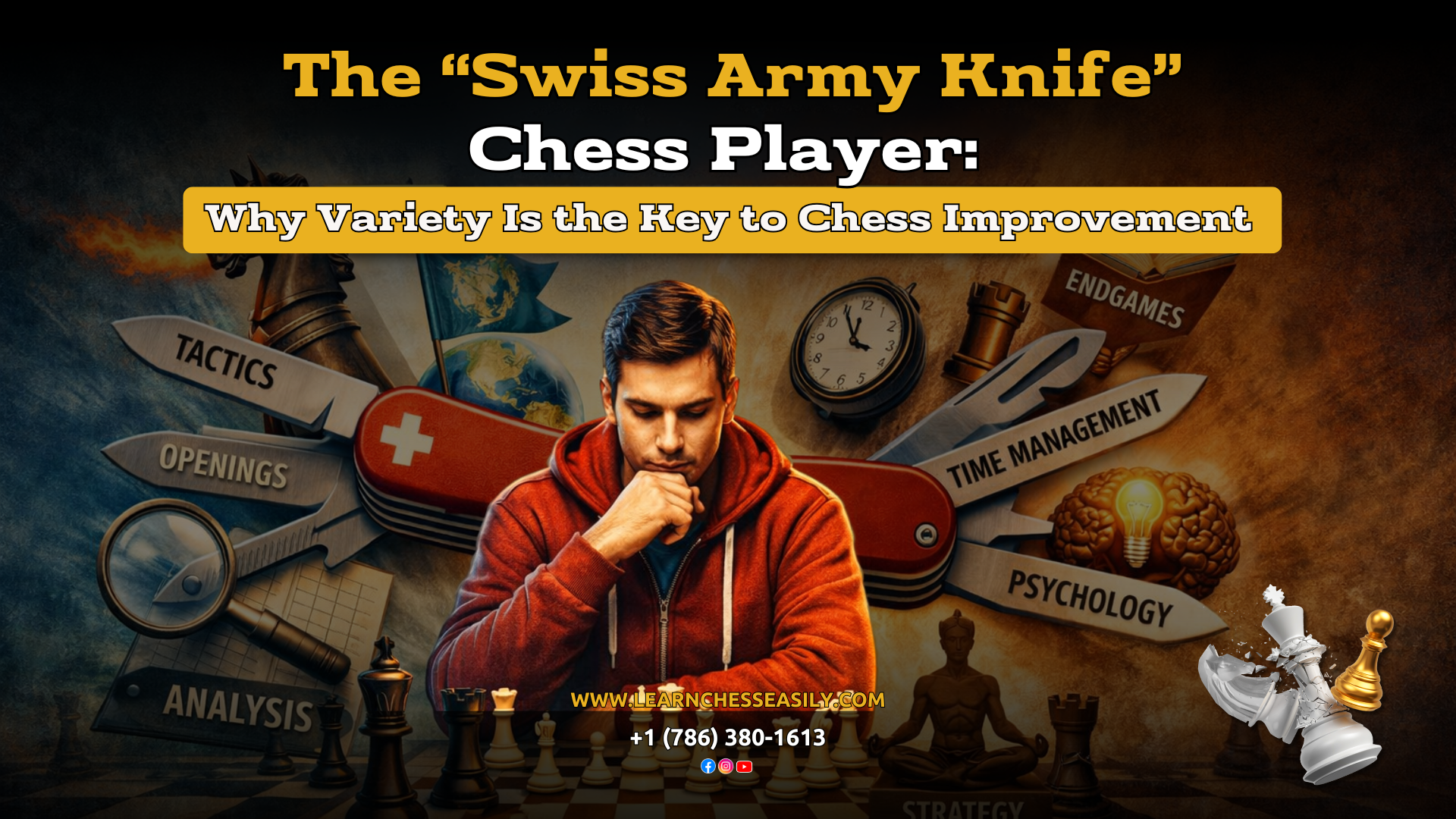
This article explains why becoming a “Swiss Army Knife” chess player is essential for long-term improvement.
Why Variety Matters in Chess Training
In cybernetics, Ashby’s Law of Requisite Variety states that control of a system requires equal or greater variety than the system being controlled.
Chess positions are complex and unpredictable. Therefore, a player who only understands one type of position will struggle when confronted with something new.
Strong players develop flexibility by training across multiple areas:
- tactical positions
- positional structures
- defensive situations
- attacking opportunities
- different pawn structures
This diversity builds a mental library of patterns that allows players to respond effectively to unexpected positions.
Chess Training for Children: Building Internal Variety
When teaching chess to children, variety is critical.
Instead of forcing young players to memorize long opening lines, coaches should expose them to different types of positions and ideas.
Effective methods include:
- solving tactical puzzles
- playing different openings
- exploring various pawn structures
- analyzing diverse game styles
This approach develops a child into what could be called an architect of the chessboard, someone capable of adapting creatively to new situations.
Chess Training for Adults: Becoming a “Chess Conductor”
Adult players often fall into the trap of over-specialization.
They memorize deep opening theory, but struggle when the opponent deviates early. In the modern era of chess engines and AI analysis, memorization alone offers little advantage.
Instead, adult players should focus on becoming conductors of strategic ideas, connecting knowledge from:
- openings
- middlegame strategies
- endgame principles
The goal is to understand how ideas interact, not simply to repeat theoretical lines.
Practical Training Tip
To build chess versatility:
- Study different openings each month
- Solve both tactical and positional puzzles
- Analyze games from players with different styles
Over time, this creates a broader and more flexible understanding of the game.
Conclusion
The strongest chess players are not rigid specialists. They are adaptive thinkers capable of handling any position.
By developing variety in training, players evolve from memorizing moves to understanding chess as a dynamic system.
This is the first step toward mastering the game.
References
Ashby, W. R. (1956). An introduction to cybernetics. Chapman & Hall.
 English
  Spanish