
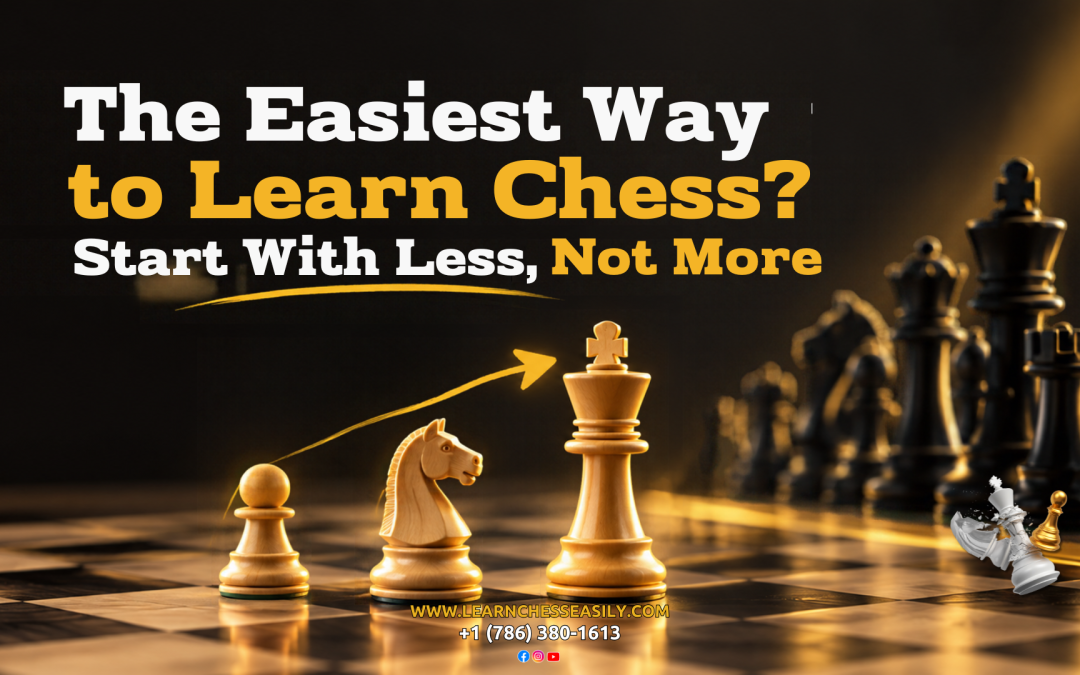
The Easiest Way to Learn Chess? Start With Less, Not More
What if the best way to learn chess isn’t to learn everything at once?
Not long ago, we received a thoughtful message from one of our Facebook viewers about The 3-Piece Pawn Game™. Their reflection captured something at the heart of my philosophy: learning chess should build confidence, not overwhelm beginner players.
Traditional chess instruction often begins by introducing the entire board: pawns, knights, bishops, rooks, queens, kings, special moves, rules, notation, strategy, and sometimes even tactics—all within a relatively short period. For an experienced player, this may seem perfectly normal. For a beginner, however, it can feel like being asked to understand a new language before having the chance to speak a single sentence. They may begin to think the problem is their ability. Maybe chess is too difficult, they aren’t talented enough, or they simply “aren’t chess people.”
But sometimes the problem isn’t the learner. Sometimes it’s the learning sequence.
Is there another way?
A Simpler Way to Learn Chess for Beginners
With The 3-Piece Pawn Game™, I take a different approach to teaching chess. Instead of asking beginners to understand every chess piece and all of its possibilities right away, I start them with just three pieces: pawns, knights, and kings.
The remaining chess pieces are introduced gradually as the player becomes more comfortable with the board and pieces movement. The goal isn’t to make chess less challenging. It’s to make the learning process more manageable.
Confidence Comes Before Complexity
One sentence from the message from our Facebook viewer stood out:
“A beginner can start making decisions and experiencing the game much sooner.”
With fewer pieces on the board, beginners face fewer possible decisions. They can begin moving pieces, recognizing patterns, making mistakes, solving problems, and—most importantly—playing chess! Rather than spending all their time trying to remember rules, they begin experiencing the game. That first experience can transform uncertainty into curiosity, and curiosity is one of the most powerful engines of learning.
Mistakes Become Part of the Game
Simplifying the learning environment also gives beginners more opportunities to experiment, and experimentation means making mistakes. In chess, mistakes are part of learning.
A player moves a pawn too quickly and discovers a weakness. A knight moves to the wrong square and becomes difficult to reposition. A king becomes exposed. Instead of merely hearing a rule from a teacher, the student experiences why the rule matters.
Chess Can Teach Us Something About Learning
The message we received ended with a fascinating question:
What if learning were less about how much we can absorb at once and more about building understanding one step at a time?
It’s a question worth considering because everyone learns differently. Children learn differently from adults. Some students enjoy competition immediately, while others need time before they feel comfortable competing. Some aren’t afraid of failure; others need several small victories before they begin trusting their abilities.
Personality, previous experiences, patience, and confidence can all influence how someone approaches a difficult new skill. Yet one principle remains remarkably powerful:
Progress builds confidence, and confidence encourages us to keep going.
That’s the philosophy behind The 3-Piece Pawn Game™ and the teaching approach at Learn Chess Easily. Instead of placing the entire complexity of chess in front of a beginner, we can open the door gradually—one piece, one decision, one discovery, and one game at a time.
Before long, something that once looked impossibly complicated begins to make sense.
Ready to Learn Chess the Easy Way?
Whether you’re a parent introducing chess to your child, an adult who has always wanted to learn, an educator looking for a more approachable teaching method, or simply someone curious about the game, your first chess experience doesn’t need to be overwhelming.
Start small. Build confidence. Learn step by step. And enjoy the journey.
Discover The 3-Piece Pawn Game™ method I teach in my book and experience a simpler approach to learning chess. Because sometimes the easiest way to understand a complex game is surprisingly simple: start with less and let your knowledge grow with every move.
See you at the chessboard,
Coach AL